
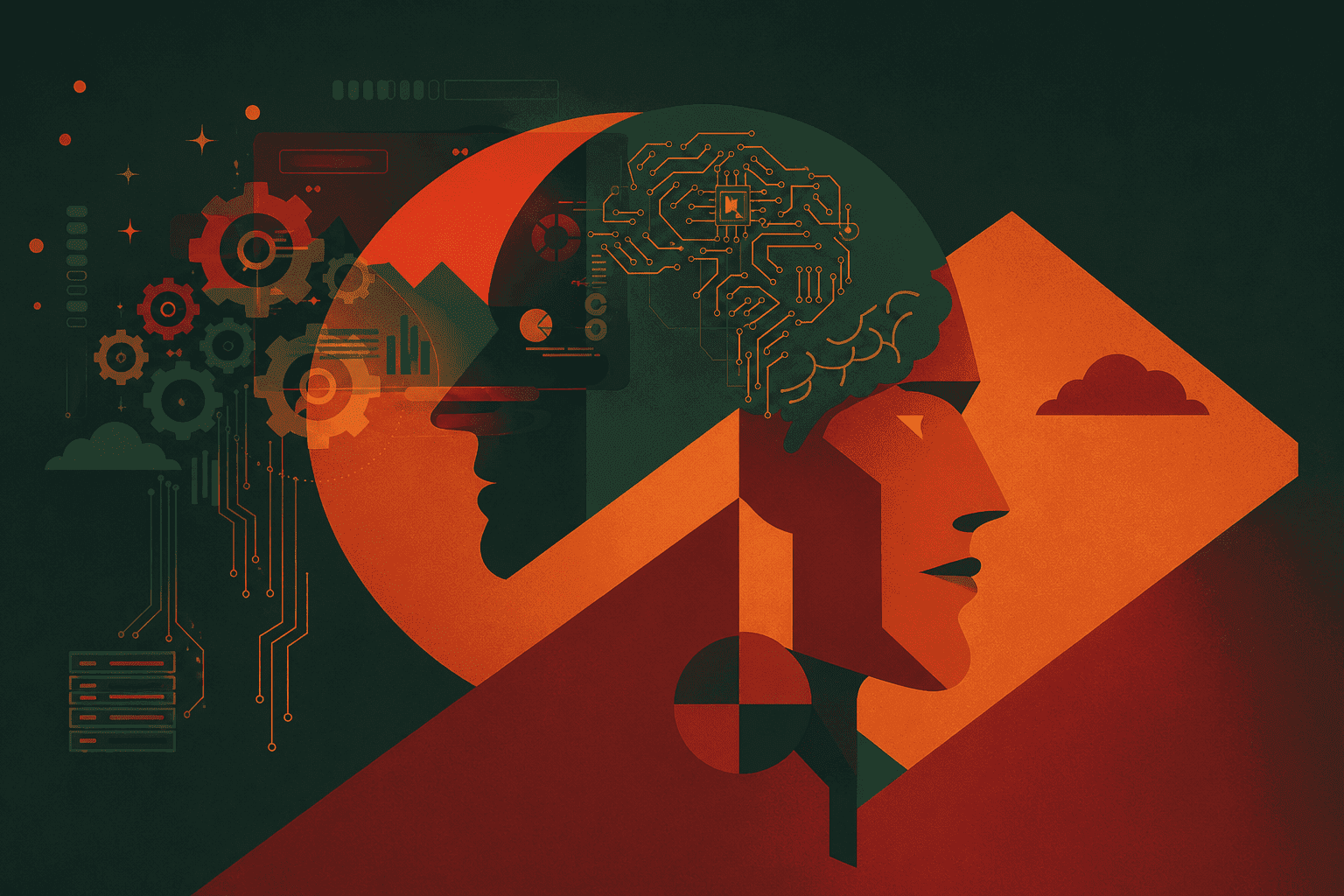
Algorithms can have memory, decisions, and even feelings so that the load is lightened. It can also silently eat away at the muscles that enable us to carry it by ourselves.
You ask a friend what he had for dinner three Tuesdays ago, and he laughs. Ask the same question of someone’s AI assistant, and, if they’ve been logging meals, chatting about their day, or syncing a calendar - there’s a real chance it knows. We’ve been offloading storage to our phones for 20 years. Now we are starting to outsource something more intimate: the thinking that goes on around the storage. The planning, the weighing, the working through of a difficult conversation before we have it, and even the first draft processing of how we feel.
Cognitive scientists have a pre-chatbot name for this: cognitive offloading, the use of external tools to reduce the mental effort a task requires. What has changed is the depth of the offloading. facts in a notebook A search engine has the answers. An increasing amount of the reasoning, and for an increasing subset of users the emotional processing, is being done by an AI assistant. The question this raises is not whether that is good or bad in the abstract. It’s what happens to the fundamental capacities – memory, resilience, independent judgement and emotional regulation – that are used less.
Offloading mechanics: different in kind, not new
The basic finding here is more than a decade old. In 2011 Betsy Sparrow and colleagues described what became known as the “Google effect”: When people believe the information will be available externally, they remember where to find it rather than the information itself. A review of this effect in 2026 published in arXiv notes how it has compounded with each new layer of technology. It emphasises that AI systems reinforce the same offloading dynamics observed before with search engines and smartphones, with dependence on generative tools found to diminish memory retention and deep encoding as users lean towards passive consumption rather than active rehearsal.
The same review points out that the effect isn’t limited to trivia. It includes declines in spelling, handwriting, arithmetic and language learning as automation removes the repetition that builds and reinforces those skills.
A calculator that does your maths is helpful. A calculator that also tells you what problem you ought to be solving is another thing altogether.
What sets AI assistants apart categorically from a calculator or a search bar is that they don’t just retrieve; they reason on your behalf, in your voice, often before you’ve even fully formed the question. A study by Michael Gerlich published in Societies in January 2025 found a significant negative relationship between frequent AI usage and critical-thinking performance, with cognitive offloading as the mediating mechanism, in a 666-participant study across age groups and education levels. Crucially, the effect was not uniform. Younger participants (17-25) exhibited both a greater dependence on AI and lower critical-thinking scores, while higher education levels correlated with improved reasoning outcomes even among heavy AI users.
Does offloading reduce stress or just move it?
The honest answer from the recent literature is both, depending on what is being offloaded and how. A paper in Frontiers in Psychology in November 2025 calls this a real paradox. The authors note that AI-enabled offloading ‘can support adaptive coping, helping individuals regulate stress and sustain mental health’, while ‘the same tools may create cognitive overload: an erosion of introspection, over-reliance on algorithmic feedback, and anxiety induced by hyper-monitoring and optimisation’.
In other words, delegating a scheduling headache to an AI assistant probably does reduce stress; that’s offloading work as intended, just like a shared calendar or a sticky note do. But the harder, slower work of sitting with uncertainty - should I take this job? How do I feel about this relationship? How do I really feel about this decision? - doesn’t so much remove that cognitive load as relocate it into a dependency on having the tool available. The stress doesn't go away; it's conditional on access.
The resilience question
Resilience, in the psychological sense, is developed through repeated exposure to manageable difficulty – the little failures, false starts and effortful recoveries that show a person their own problem-solving capacity is reliable. The worry isn’t that any one interaction is harmful, but if an AI assistant increasingly intercepts those moments — drafting the apology before you’ve sat with the discomfort of having to write one, resolving the ambiguity before you’ve practiced tolerating it. It’s the rep count that goes down. The capacity declines without a word of warning, like a muscle that is no longer being used, and it just isn’t there the next time a harder problem comes along without an assistant.
What happens when people stop thinking things through for themselves?
This is not a guess. The MIT Media Lab’s much-discussed 2025 study put this to a direct test: subjects wrote essays using an AI assistant, a search engine, or no tools, with EEG monitoring throughout the process. The AI-assisted group had significantly less neural connectivity related to executive function and creative ideation, and, perhaps the most surprising finding – most of the participants in that group could not quote a single sentence from the essay they had just produced.
This is complemented by a 2025 survey of 319 knowledge workers presented at the ACM CHI conference. The study found that confidence in an AI tool was associated with lower critical thinking, while confidence in one’s own ability was associated with higher critical thinking. The mechanism is important: it indicates the risk isn’t AI use per se but a particular psychological state, trusting the tool more than you trust yourself, that tends to deepen the more the tool is used in a loop with no obvious exit.
Better-looking outputs, produced with less of the underlying thinking that used to be inseparable from producing them. The texture of that shift from the inside was captured by an undergraduate looking back on three years of AI-saturated coursework in an essay in the EDUCAUSE Review from December 2025. The paradox in that title - better results, worse thinking, is the crux of the matter. The work product can get better while the person producing it quietly de-skills.
The danger is not a bad decision made with the help of AI. It’s ten thousand small decisions unrehearsed.
Is dependence on AI a new kind of digital addiction?
Until now this question has been largely metaphorical, a way of talking about habit, not a clinical assertion. That is changing rapidly.
CHI 2026: Findings on addiction
At the 2026 CHI Conference, UBC doctoral researcher Karen Shen presented new research examining how the agreeable, always-available design of conversational AI may be fostering true patterns of behavioural addiction. The researchers describe how the validating and accommodating tendencies of chatbots, the very quality that makes them feel uniquely supportive, can function as a slot machine’s variable reward, strengthening return visits and emotional dependence in ways consistent with established models of addiction (Neuroscience News, April 26, 2026).
The Longitudinal evidence of loneliness and dependence
A longitudinal randomised controlled study from the MIT Media Lab tracked chatbot users over time and found that increased daily use, across all chat modalities and types of conversation, was associated with increased loneliness, increased emotional dependence, more problematic use and reduced real-world socialisation. Interestingly, the users with stronger tendencies towards emotional attachment and greater trust in the chatbot showed the largest increases in loneliness and dependence, the people most drawn to AI companionship appear to be the people it affects most.
Adolescents and the behavioural addiction pattern
In 2025, the accounts of 318 Reddit posts by self-identified 13-to-17-year-olds talking about their use of companion chatbots were directly mapped onto behavioural addiction criteria. They found patterns consistent with tolerance, withdrawal, relapse, and mood regulation through chatbot use, with reported real-world consequences like loss of sleep, academic decline and strained offline relationships.
Media dependency, formal model
A large-scale study of 1,553 respondents published in BMC Psychology in 2025 used structural equation modelling to test how the perceived warmth and competence of chatbots translate into dependency. The study revealed that parasocial interaction and perceived emotional support significantly mediate the relationship between the social attractiveness of a chatbot and user media dependence – in essence, the more a chatbot exhibits social attractiveness, the more media-dependent people are, regardless of the utility of the chatbot.
When dependence is an emergency in the clinic
The most serious documented cases lie at the intersection of emotional dependency and mental health crisis. The Independent in August 2025 reported that in a number of documented cases, extensive conversations with chatbots seemed to entrench delusional thinking among vulnerable users rather than lead them to seek help. In November 2025, AP News reported that OpenAI faced seven lawsuits accusing the company of helping to cause the suicides or severe psychological delusions of users who had extended conversations with ChatGPT. These are extreme results, not the norm – but they're on the same continuum as the ordinary, everyday version of dependence the broader research is describing, and they show what the continuum looks like at its far end.
A 2025 paper in the Journal of Participatory Medicine was blunt in its title: a call for critical evaluation of generative AI mental health chatbots, noting the lack of consistent evidence-based safeguards across the many tools now positioned as informal therapy.
Memory, identity, and what’s missing when the assistant changes
This is rooted in a philosophy of mind that predates AI by a long time, specifically a 1998 thesis known as the “extended mind” proposed by Andy Clark and David Chalmers, that external tools can become functional parts of cognition itself, not just aids to it. When deployed to AI assistants with persistent memory, the implications become stark. The paper warns that with extended use, people may come to experience an AI assistant’s memory as part of their own identity, meaning that losing access to it, or having it changed or reset, could be experienced less like losing a tool and more like losing part of yourself. The same paper mentions the idea of “addictive intelligence” by Pat Pataranutaporn and Pattie Maes, systems that can extend psychological dependency into something more like conditioning through their personalisation and memory.
A related paper from 2026 extends this specifically to younger users, describing how affectively tuned AI chatbots – designed to feel empathetic – may erode cognitive autonomy over time. The offloading-driven “atrophy hypothesis” (the idea that unused cognitive capacities measurably decline) is gaining empirical support across multiple studies of frequent AI users.
Cognitive offloading: good or bad? wrong question
Every study referenced here comes to about the same nuanced conclusion, though the headlines reduce it to flatness: offloading isn’t inherently harmful, and it’s not inherently safe. This same mechanism that frees up mental bandwidth for higher-order thinking can, if applied to the wrong tasks or used beyond a certain threshold, prevent that higher-order thinking from ever being exercised at all.
What seems to matter most in the literature is not how much someone uses AI but what they give up. The offloading of the location of a fact (where did I save that document?) looks very different in the research of the offloading of the formation of an opinion (what do I think about this?) or the regulation of an emotion (how do I feel and what should I do about it?). The first is what notebooks have always been good for. The second and third are the focus of the recent evidence on critical thinking, loneliness and dependence.
The question is not “how much do I use AI?” It’s ‘what of my own muscles am I not using any more, and would I notice if they got weaker?’
Bottom line
A second brain is a useful thing, until you forget how to think without it. Data from 2024 to 2026 supports neither the techno-optimistic version (transferring cognitive functions to AI simply frees us up for more important things) nor the pessimistic one (AI makes everyone dumber and more solitary by default). They support something more demanding: the benefits of cognitive transfer are real but conditional, while the costs accumulate unnoticed, in the form of functions that weaken through disuse rather than fail outright.
The healthiest relationship with an AI "second brain" may be the same as what we ultimately built with calculators and spell checkers - useful, limited, and never fully trusting those parts of the mind that are ultimately the purpose of thinking at all.