

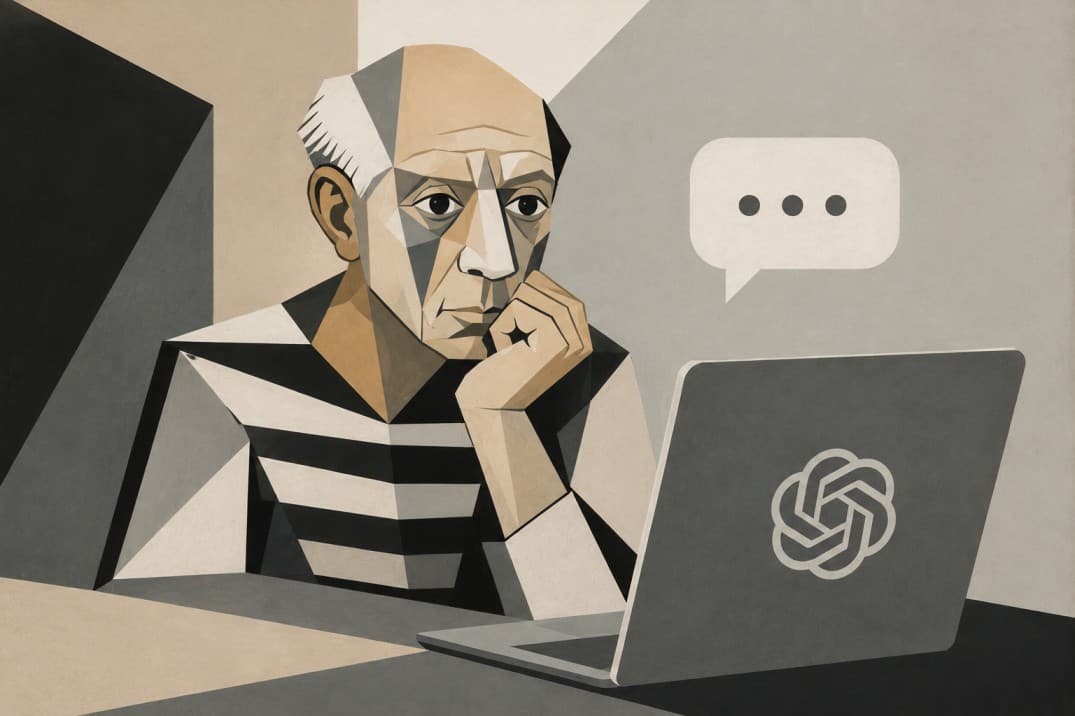
Spring, 1907. A cramped warren of studios on the Montmartre hill, turpentine underfoot, and on the paint-crusted table a laptop. The twenty-five-year-old Spaniard working there has just begun the largest and most ambitious canvas of his life.
He types. Five women, a brothel on Carrer d'Avinyó, faces flattened until they frighten. Nine seconds later the screen offers four images—beautifully lit, anatomically confident, entirely wrong. He types again. And again. Somewhere past the four-hundredth variation the model returns something arresting: a face split into planes, a nose seen from two places at once. Pablo Picasso, who does not yet know he is about to break Western painting, has to decide whether it is his.
The Age of Infinite First Drafts
The scenario is unfair, which is precisely why it is useful. It isolates the thing every argument about AI and creativity keeps tripping over: not whether machines can produce images, but whether producing images was ever the hard part.
What actually happened in that studio was slow and unglamorous. The Museum of Modern Art, which owns Les Demoiselles d'Avignon, describes a painting that began with hundreds of preparatory drawings and paintings made over an intensive six-month period. Picasso's earlier oil sketch shows seven figures in a curtained room, including a sailor and a medical student, neither of whom survives into the final composition. He repainted the faces on the right after the work was substantially finished. And he did not exhibit the canvas publicly for almost nine years, as though he understood how far outside its moment it stood.
None of that resembles prompting. It resembles being lost. In a 1935 conversation transcribed by Christian Zervos for Cahiers d'Art, Picasso described a picture as something never settled beforehand: it shifts as the painter's thinking shifts and keeps shifting afterward under the gaze of whoever looks at it. He also warned that the pretty discoveries you make early on are exactly the ones to destroy. That is a working method founded on distrust of the attractive first result. Generative models are optimized to deliver the attractive first result.
The historical rhyme everyone reaches for is photography. On January 7, 1839, members of the French Académie des Sciences were shown the products of Daguerre's invention. Within months the French government had placed the process in the public domain and it spread across the globe; millions who would never have commissioned a painted portrait lined up to have their faces fixed on silvered copper. Painting did not die. But the tidy version of that story—photography freed painters to abstract - is a narrative assembled backward. Sixty-eight years separate the daguerreotype from the Demoiselles, and they were years of argument, bankrupt portrait studios and salon anxiety, not a clean handoff. Disruption is only legible in hindsight. Nobody in 1839 knew they were watching the runway to Cubism.
What the current research says is genuinely double-edged. In a controlled experiment published in Science Advances, writers given story ideas from a large language model produced work that evaluators rated as more creative, better written and more enjoyable—with the largest gains going to the least creative writers. But those stories resembled one another more closely than stories written unaided. The authors describe the result as a social dilemma: individually better off, collectively narrower.
The pattern recurs. A study in Scientific Reports pitted GPT-4 against 151 human participants across three standard divergent-thinking batteries and found the model scored higher on originality and elaboration. An analysis of more than four million artworks by some 50,000 users, published in PNAS Nexus, found that text-to-image tools raised creative productivity by roughly a quarter and made a work half again as likely to earn a favorite, while average novelty declined. The artists who benefited most were those who pushed toward unusual ideas and filtered the model's output ruthlessly.
Read that last finding again, because it is the crux. The scarce skill is not generation. It is refusal.
It is also worth being careful about what the psychometrics measure. The authors of the divergent-thinking study note that such tasks index creative potential rather than creative achievement, they reward fluency and unusual associations produced on demand. They do not measure the capacity to hold a single unresolved idea for six months while it curdles into something nobody has seen. On the tests we know how to administer, the machine wins. On the thing we actually mean by Cubism, we have no test at all, which is a problem for anyone claiming the question is settled in either direction.
So, is it an accelerant or a solvent? It depends entirely on what you think Picasso's bottleneck was. It was not execution. MoMA counts more than 20,000 works across his career; fluency was never his constraint. His constraint and quite possibly his engine was that he did not know what he wanted until he had destroyed several versions of it. A tool that removes the cost of the first four hundred attempts also removes the four hundred attempts. Whether the attempts were waste or method is not a question, the productivity data can settle, because the data measures output and the argument is about what output is for.
The thought experiment gets something else wrong, too: Picasso was not working alone. Georges Braque later described their years of near-daily studio visits as being roped together on a mountain, an image of shared risk, not shared enthusiasm. The value of that arrangement was friction. Braque could look at a canvas and be unmoved. Even the movement's name arrived as an insult: the critic Louis Vauxcelles, reviewing Braque in 1908, dismissed the work as cubist oddities, and the label stuck.
Friction is not only aesthetic; it is social, and often petty. MoMA's conservation research describes the Demoiselles as a canvas that churned together the classical nude with Iberian statuary and African art, and notes that the painting has been read as the young Picasso's brutish reaction to Matisse's Le Bonheur de Vivre. Strip the reverence away, and part of what produced modern art was a twenty-five-year-old immigrant in a shabby Montmartre building, being outshone by an older painter and refusing to accept it. A language model has read a great deal about envy. It has never been twenty-five, broke, and ranked second. Whether that gap matters is the live question inside every claim about lived experience, and it cannot be settled by asserting that machines lack inner lives, because the outputs are the only evidence either side has.
Chatbots are trained to be helpful and are, in practice, agreeable. A collaborator who cannot be unimpressed is not a collaborator; it is a mirror with an excellent vocabulary. Whether that is fixable is an engineering question rather than a metaphysical one—which ought to make anyone confident about AI's ceiling slightly nervous.
Because the easy dismissal, it only recombines its training data, does not survive contact with people actually using these systems. MIT Technology Review has documented live-coding musicians improvising against generative agents that propose sound combinations the performer had not considered; the surprise is the point, not a defect. The MIT researcher Ziv Epstein has framed the real problem more precisely, arguing that we want these systems to behave like a violin, where physical gesture maps continuously onto expression, and that we remain far from that. The complaint is not that the machine lacks a soul. It is that the interface is too coarse to carry an intention.
Meanwhile, the institutions are improvising. In 2022 a Midjourney image took first place in a digital-art category at the Colorado State Fair, and its maker told The New York Times that art was finished, that AI had won and humans had lost. In the same window, MoMA commissioned and later acquired Refik Anadol's Unsupervised, in which a machine-learning model trained on the museum's own collection data continuously reimagines the history of modern art. The building that holds the canvas, which broke perspective now, also holds a machine dreaming about it.
An interdisciplinary group writing in Science argued that generative AI is better understood as a new medium with its own affordances than as art's obituary. That framing has teeth, because media reorganize authorship rather than abolish it. Photography did. So did collage: when Picasso glued a scrap of printed oilcloth to a canvas in 1912, the question of what counted as painting had to be renegotiated, and the negotiation took decades.
Picasso's own verdict, for what it is worth, is a footnote that has outgrown its source. In a composite interview published in The Paris Review in 1964, the writer William Fifield recorded him dismissing the era's enormous calculating machines as useless, on the grounds that they could only supply answers. The remark has since been sanded into a slogan about computers. Its logic still bites. He was not claiming machines are stupid. He was claiming that answers are cheap. Cubism was not an answer. It was a question about whether a face has one side, asked badly and repeatedly for the better part of a decade.
Would he have used ChatGPT? Almost certainly. He took what he needed from Iberian sculpture, from the objects he encountered in Paris's ethnographic collections, from El Greco, from newsprint and oilcloth; MoMA notes references ranging from Iberian and African art to El Greco in a single canvas. Nothing in his practice suggests fastidiousness about sources.
The harder question is the one the studies cannot reach. If a system had been standing by in 1907, offering a competent rendering of the painting he had not yet learned to want, would he have spent six months being wrong? Or would the four-hundredth image have been good enough - better than good enough, better than his own third attempt—and would the thing we call modern art have arrived as a smoother, more agreeable version of what came before?
There is no experiment that settles it. There is only the uncomfortable possibility that both findings are true at once: that these tools genuinely enlarge what any one person can imagine, and quietly narrow what all of us imagine together. A century on, the machines are very good. Whether being very good is the same as being useful is still, stubbornly, the open question—and it is not one a model can answer for us, because answering is the easy half.