

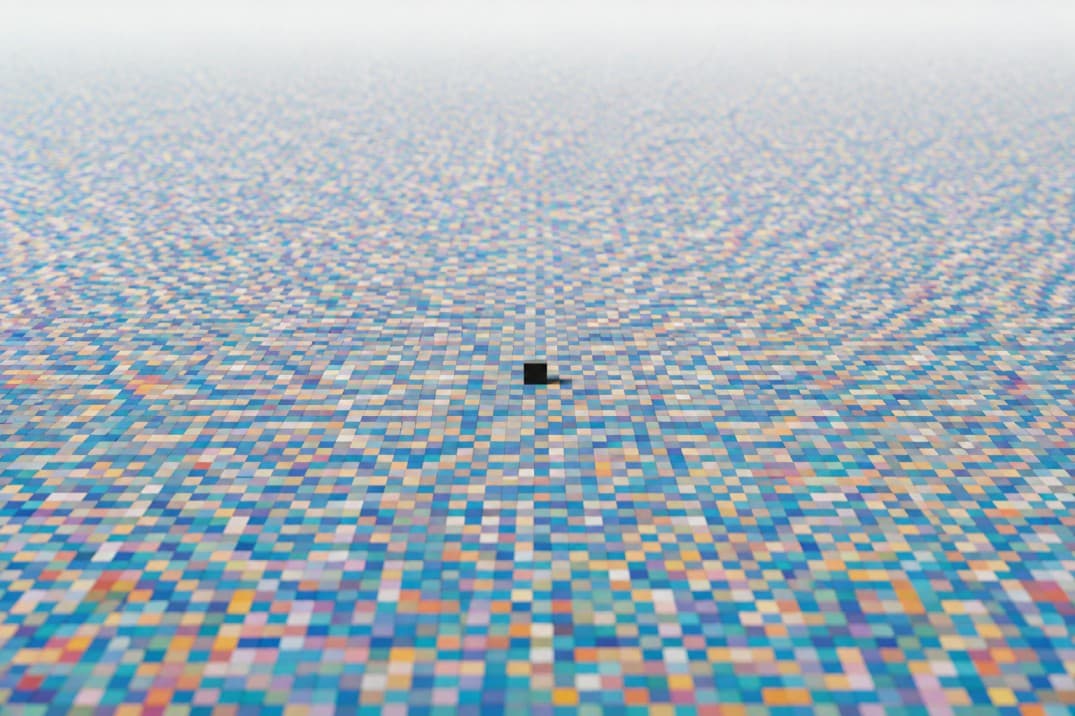
The flood
There was a term for it by the time 2024 drew to a close. The MIT Technology Review put a name to the year’s toll on the internet, noting how social feeds, ads and book listings had been overrun with a certain kind of image: quick, capable and ultimately forgettable. It and all the rest of us came to know it as AI slop.
The publication dispatched a reporter to the feeds in the following year to make sense of the short video clips that were impossible to avoid on TikTok or Instagram, from a rabbit on a trampoline to every other creature and thing one could imagine doing the same. One would be hard pressed to call the images ugly; in fact, that is the uneasy consensus among those covering the subject. They are well-lit, smooth and technically proficient, yet five minutes after viewing them there is no recollection of having seen them at all.
To put it plainly, this is what the crisis is about, and not the easy narrative that AI produces bad art. The models have, if anything, mastered the sort of beauty that once demanded skill – proper composition, anatomy, and color. What has given way is not quality but scarcity. And as it happens, scarcity was shouldering more of the economic burden of beauty than was apparent.
The case for scarcity
Cognitive science offers a rather blunt account of how abundance can defang an image before it is even put to judgment. There is the matter of the mere-exposure effect, a concept made formal by Robert Zajonc and honed in subsequent decades of replication. It demonstrates that we come to like a stimulus more with repeated exposure because of processing fluency; the brain interprets the ease of it as a subtle positive and wrongly ascribes that to the object. A recent reassessment in the Journal of Experimental Social Psychology has borne out the robustness of this in all sorts of contexts, aesthetic preference included.
But there is a flip side to the mechanism that AI makes plain: while fluency is easy to put together, it is hard to keep up. An afternoon’s work with a generative model will yield ten thousand images of technical fluency. The problem is that you cannot make any of them feel newly earned. Once you strip away scarcity, fluency ceases to mean anything. One does not become fond of the ten-thousandth sunset by mere exposure.
We have seen this sort of thing before. The example of 1839 is instructive for what did not happen according to the doomsayers. When Louis Daguerre put his process in the public domain, it was not long before it had gone global and millions were lining up to have their features captured on silvered copper, something a painted portrait would have been beyond their means. Portraiture, the Western art form most at risk from a faster, more accurate, and less expensive rival, did not simply disappear. It became odder. With the camera of 1840 out of the way, painters no longer vied for likeness but for what the device could not do, paving the way for Impressionism and the likes of abstraction.
One might be tempted to see this as proof that matters always right themselves, but that is a poor generalization. A better reading of the evidence is that when a technology turns one axis of value into a commodity, it compels competition to move to another, and there is no vote on where that may be.
The data is clear on what endures
As for the axis of change, the research in an awkward way points to a number of possibilities at once, and that is precisely the point: beauty has no one true heir, but rather a collection of qualities that are difficult to automate.
Consider selection in the face of abundance. It is not as simple as it would seem. A PNAS Nexus study of some four million works from fifty thousand users or so revealed that while artists making use of text-to-image programs saw their output and audience favorability go up, the novelty of the average piece did not hold. Only a few standouts were more novel than before. The ones to come out ahead were those who put in the work to explore and then discarded most of what they made. In short, the bottleneck was not removed by abundance but simply shifted from the hand to the editing process.
Science Advances has a story to tell along the same lines. Writers with AI to suggest plot ideas turned in individual pieces that were deemed more creative, yet as a body of work the stories became more like one another. It is a kind of underappreciated arithmetic where beauty is locally plentiful and globally repetitive; everyone’s numbers may be better, but the variety in the culture at large is diminished.
Trust is the second candidate, and one can see the market has started to put a price on it. Take Coca-Cola’s 2024 AI holiday campaign, for instance. The company put out an ad that was, in all the formal ways of the trade, a competent piece of work: well lit, properly composed, and on-brand. Yet the backlash came fast. No one was complaining about the look of it; rather, viewers could tell what they were looking at, and in doing so the ad’s warmth seemed manufactured instead of genuine. For its part, Coca-Cola has put forward the defense that its output is where human ingenuity and technology meet, but that very need to justify the provenance of a picture is telling. It is a sort of dispute a Norman Rockwell illustration would never have occasioned.
There is now an infrastructure to handle such disputes. Since 2019, Adobe has been at the helm of the Content Authenticity Initiative with the BBC, Microsoft and others to create an open standard for cryptographically signing the provenance of video and images. It is a technical solution to what would have been considered a category error ten years ago: not whether an image is beautiful, but whether it can vouch for its origins. Provenance may not be an aesthetic in itself, but it is handled as such. In a world where execution is free, the narrative of who made something and to what end is one of the few things a model cannot be asked to produce.
You will find this kind of compression in any area where beauty has been standing in for something else. A portfolio image of some polish once served as proof of the maker’s judgment, patience and taste. But when anyone with a text box can turn out a technically flawless and striking image, that link is severed; the skill is no longer a prerequisite, so the image can no longer be taken as evidence of it. The PNAS Nexus and Science Advances have put their finger on this from the production side, noting more polish and less signal. It is why design studios and architecture firms are making a point of documenting process and provenance to demonstrate competence. When the artifact ceases to be convincing, institutions will seek another to make the case.
One might call it an imperfection premium
Design as a field is no stranger to the concept; long before the term “prompt engineering” came into vogue, the discipline had already made sense of scarcity as a form of value. Take Sen no Rikyū, the sixteenth-century tea master who put wabi-sabi on a formal footing. He would have you believe that a polished Chinese import was not true luxury when set against an irregular, unadorned utensil of his own making. To Rikyū, beauty without some visible constraint was of a lesser order. Then there is kintsugi, with its gold-dusted lacquer mending for broken pottery. It is a step beyond: rather than covering up a defect, the practice puts it on display as the piece’s most valuable attribute.
There is a neatness to the parallel with an age where frictionless perfection can be downloaded at will, but the point is more than poetic and can be put to an empirical test. The underlying proposition is that what the signaling is not symmetry or a fine finish, but the evidence of cost and choice.
Can such a signal stand up to imitation? That remains to be seen, and there are grounds for skepticism. A generative model is just as amenable to being cajoled into imperfection as it is to perfection, producing its share of off-center compositions and film grain. In that way, an authentic look is as automatable as a polished one, and far simpler to put on than to prove. Should imperfection be reduced to a filter, it ceases to denote scarcity and means nothing. What commands a premium then is not visual roughness, but some proof of an irreversible decision or real expense on the part of a human. A filter can do the artifact, but it has little success in replicating the stake.
What actually resists
On the question of what stands in the way, there is a structural case to be made that the dearth of beauty we can put our trust in will only intensify. One need not look far for evidence: in Nature, Ilia Shumailov and his team have shown how generative models collapse when they are fed their own past work without discrimination. The result is an irreversible decline, with the odd or tail-end examples being the first to go.
As the internet fills with AI-made imagery, any model trained on it will tend to drift toward the visual mean of what is already out there. It will be more competent but also more repetitive, lacking the capacity for the true outliers that give us the sense of originality. In a way, beauty is becoming common because at the level of the training data it has come to resemble what was already there.
Humans are left to wonder where this puts them. The economics of generative labor provide an answer, though not one as flattering as is often proffered. Consider the findings in The Quarterly Journal of Economics from a study of some 5,000 customer-support agents: AI help did little for those who were already top notch and in some cases slightly eroded the quality of the very best, while it had the effect of pulling up the weakest to the level of the strong.
There is reason to think the same kind of compression holds for visual craft, according to novelty data in PNAS Nexus. Which means those whose output AI cannot really better were never simply beautiful in the first place. Ted Chiang puts it more sharply in The New Yorker, making a point of mechanism over mere taste. Art, he says, is what is left after an inordinate number of choices, small and otherwise. A machine-generated image will average out the ones nobody bothered to make. So if you ask a model for a beautiful picture, it will oblige with something that is impressive enough and done before anyone has to want anything specific. But it is forgettable. The abundance we see is not in the quality; the scarce element was always the choices themselves.
The 808 was too fake for 1980's ears and became the sound of a decade it hadn't been built for. The daguerreotype was too accurate for painting and made painting stranger and better. What generative images are too abundant for is still being worked out in real time, across ad campaigns nobody trusts, feeds nobody remembers, and a small, deliberately narrow category of work whose maker had to decide, at some cost, not to generate the other nine hundred ninety-nine options. Whether audiences will keep noticing the difference, or slowly stop being able to tell, is the argument this technology has actually started, not whether AI can make something beautiful, which it plainly can, but whether beauty was ever the argument to begin with.