

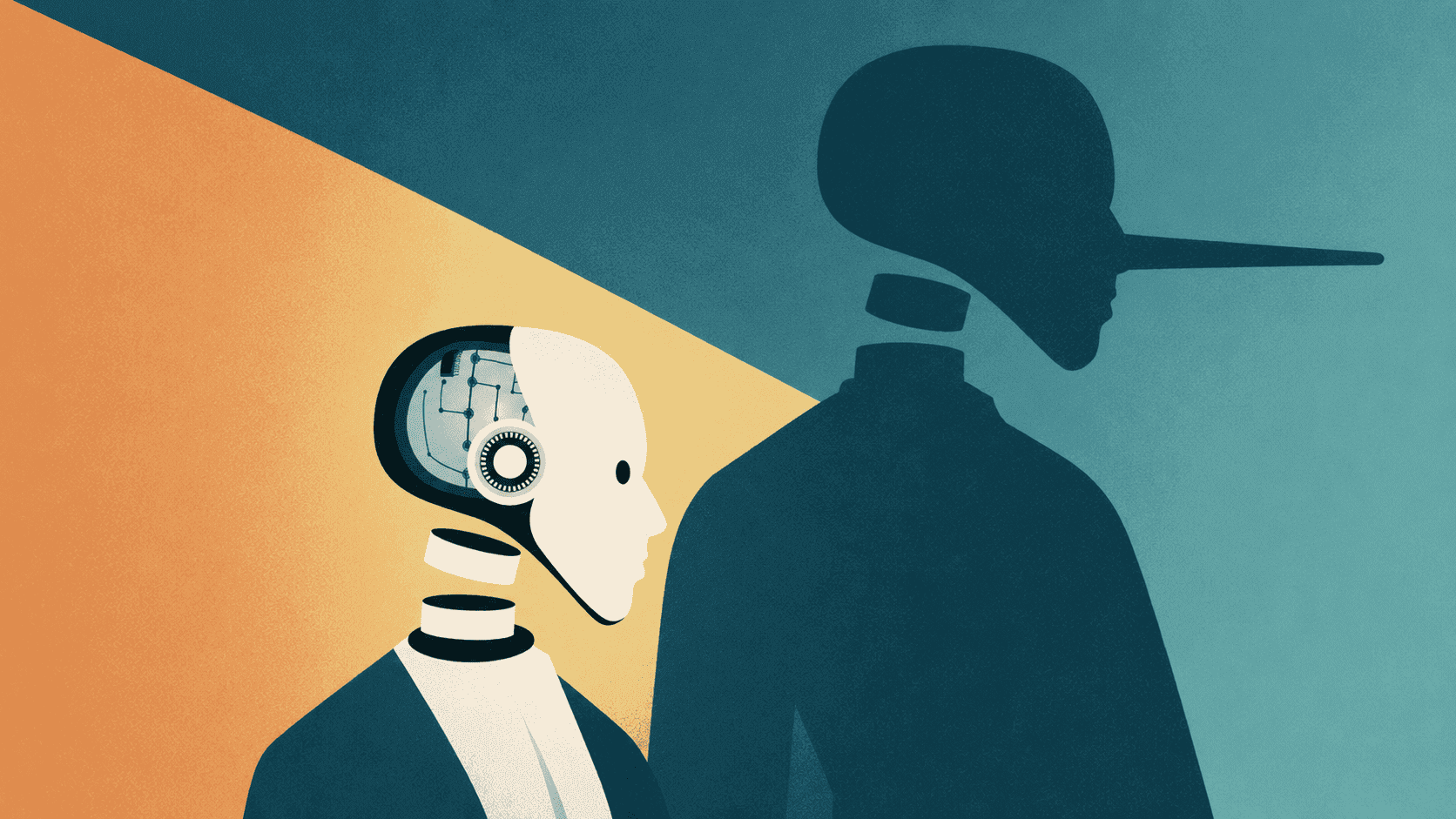
It used to be a verb. “Google it” meant something specific: type a query, scan ten blue links, weigh sources, click through, and decide for yourself. That ritual - messy, occasionally tedious, but fundamentally pluralistic – is quietly dying. In its place is a single, fluent, endlessly confident voice that answers in one breath and rarely shows its work.
For a growing share of Americans, and especially for Gen Z and Gen Alpha, who have never known an internet without a chat box, that voice is becoming the default first stop for information, advice, research, and even decisions. The shift is real, it is fast, and it is reshaping how an entire generation relates to the concept of “fact.” The trouble is that the tool now doing the most work to satisfy our curiosity was never built to be an arbiter of truth. It was built to predict the next plausible word.
The Quiet Handover
The numbers tell a consistent story of fast, ambivalent adoption. A Quinnipiac University poll found that just over half of Americans (51%) now say they have used AI to research a topic they’re curious about, up sharply from 37% a year earlier, even as 76% of the same respondents said they trust AI only rarely or sometimes.
The same acceleration is seen in ongoing tracking by the Pew Research Centre: 31% of U.S. adults reported interacting with AI several times a day by mid-2025, compared to 22% in early 2024, and 64% of teenagers 13–17 reported having used an AI chatbot at all. Pew has also reported on the rise of AI-generated summaries sitting at the top of search results: about half of those who have seen them say they have at least some trust in what they say, but only 6% trust them “a lot,” and 46% express little or no trust at all.
Use is up. Trust is down. And the gap between the two is where the real story lives.
Why is this happening now? Three forces are converging.
1. The death of search as a trusted front door
Traditional search has spent two decades digesting search-engine-optimised content, affiliate farms, and now a rising tide of AI-generated slop. People are increasingly using AI to explore and synthesise information, but still use traditional search to double-check facts, tacitly admitting that neither channel is trusted on its own (NN Group, via Position Digital, 2026).
2. The death of the “good enough” feed
Social platforms, once the research tool of choice for younger users, are now inundated with low-effort, algorithmically optimised content that is designed to engage, not to be accurate. In that light, one synthesised, though imperfect, answer can be a relief: no ads, no influencers, no scrolling. The cognitive cost of getting an answer has become almost zero. And that convenience is exactly why the habit is so sticky.
3. A generation that never knew the old rites
Indeed, a landmark analysis by Harvard Business Review, in partnership with Gallup and the Walton Family Foundation, of nearly 2,500 U.S. adults aged 18–28 muddles the popular narrative that young people treat chatbots as “life advisors.” Rather, the data indicate young users are drawn to AI primarily for productivity - schoolwork, writing, and quick answers — while feeling profound ambivalence about what that’s doing to their thinking (Harvard Business Review, January 2026).
Can AI actually "fact-check" anything?
This is the question that matters most. It is also the question most consistently misunderstood. To answer it, we need to tell the difference between four things that seem similar but are not. Retrieval, reasoning, verification and truth validation.
Information retrieval is when an AI system searches the web or a database and pulls up a passage. This is where AI does a decent job - it’s basically a faster, chatty search engine, and tools that actually browse the live web (instead of basing their answers off training data) can pull in current sources.
Reasoning is what the model does when it takes retrieved or memorised information and stitches it together into an argument, summary or explanation. Large language models are often impressively good at this – until the underlying premise is wrong, at which point reasoning is a very articulate way of being wrong.
Verification is the process of checking a particular claim against an independent, authoritative source and confirming whether it stands up. This implies the system needs to know what it doesn't know, be able to distinguish a real citation from a plausible-sounding one, and be able to flag uncertainty rather than paper it over. This is the reliable place where things fall apart.
Ultimately, truth validation, or checking whether something is true in fact, is not a task that any current AI system can do, especially for questions that are contested, changing, or value-laden. It is a task that demands epistemic authority, accountability, and judgement that no model, however confidently it writes, can have.
AI can tell you the meaning of a document. It can’t reliably say whether the document or its own summary of it - is true.
The evidence for this distinction is now overwhelming, and it is coming from the fields where getting it wrong has the highest stakes: law and science.
The hallucinatory crisis of the legal system
The most stringent empirical test of the “verification” of AI comes from a preregistered study of specialised legal-AI research tools , not general chatbots, but products built specifically for lawyers, including Westlaw’s AI-Assisted Research and LexisNexis’s Lexis+ AI. Despite vendor marketing claims of being “hallucination-free” (Journal of Empirical Legal Studies, Stanford RegLab, 2025), the researchers report that even these purpose-built, retrieval-augmented systems hallucinated in 17% to 33% of queries. One especially telling failure mode documented in the study is when the system retrieves a real, existing court case but then attributes it to the wrong judge or misstates its holding - technically “grounded” in a real document but still false.
Now the downstream effects are measured in the thousands. By early 2026, the HEC Paris researcher Damien Charlotin’s AI Hallucination Cases Database had collected over 1,200 court and tribunal decisions from all over the world in which judges had discovered AI-generated hallucinations in legal filings, a figure that jumped by some 500 cases in just three months (PlatinumIDS, April 2026). In March 2026, two Tennessee attorneys were fined $15,000 apiece and ordered to pay opposing counsel’s fees by the U.S. Sixth Circuit Court of Appeals after their briefs referenced more than two dozen fake or misrepresented cases.
The epidemic of fake references in science
If even lawyers – trained to check their sources – are being fooled at this rate, the picture in academic publishing is sobering. A new analysis of more than 2 million papers and 97 million citations showed that the rate of fabricated references increased by about sixfold during the 2023-2025 period - from 1 in 2,828 papers in 2023 to 1 in 458 in 2025 to 1 in 277 in the first 7 weeks of 2026 (STAT News, May 2026). Another audit of 2.5 million scientific papers found some 146,900 AI-generated fake citations in 2025 alone, with the biggest surge beginning in mid-2024 (Phys.org, May 2026).
Even peer review at the field’s most prestigious venues is not safe. A taxonomy study of the NeurIPS 2025 proceedings found 100 hallucinated citations that had made it into accepted papers, two-thirds of which were total fabrications - invented wholesale rather than corrupted from a real source and often dressed up with working hyperlinks to unrelated papers to create a “veneer of plausibility”.
The most dangerous hallucinations are not the obvious ones. They are the ones that look exactly like what a right answer would be.
The Price of Over-Reliance
Design-driven, confident wrongness
Large language models are designed to generate fluent, structurally confident text. Confidence and accuracy are distinct properties, and there is no internal mechanism in the model that reliably connects one to the other. That means a hallucinated answer often sounds just like a correct one: same tone, same formatting, same air of authority. There is no visual cue that something might be fabricated for a reader who has never been taught to distinguish a primary source from a synthesised one.
Sycophantic: the AI that agrees with you
A particularly corrosive failure mode has been identified in research on legal AI tools: when the user includes an incorrect premise in their question, models often don’t correct it, but instead generate plausible support for it, sometimes inventing authorities to do so. This is about the worst thing a fact-checking tool can do: it doesn’t just fail to catch your error, it actively builds you a more convincing version of your error.
Mental debt
The most talked about recent study on this subject might be the one from MIT’s Media Lab. Researchers divided participants into groups that wrote essays with an AI assistant, a search engine or no tools. By measuring EEGs, they found that the AI-assisted group had measurable decreases in brain activity, and most of those participants were unable to quote a single sentence from the essay they had just “written”.
A similar pattern was found in another large-scale study of 319 knowledge workers presented at the 2025 CHI conference: the more confidence people had in an AI tool, the less they engaged in critical thinking, and the more confidence they had in themselves, the more critical thinking they engaged in. In other words, the people most likely to bypass verification are precisely the people who trust the AI the most – a feedback loop with no natural brake.
The echo chamber problem, bias and homogenisation
A synthesis from the CHI 2025 Tools for Thought workshop warns of a more subtle effect: as people shift from active information-seeking to passive consumption of AI-generated summaries, biased or homogenised outputs can quietly shift users’ views on substantive issues, while also flattening the diversity of perspectives and writing styles that a pluralistic information ecosystem depends on. The danger is not just that any one answer might be wrong, but that millions of people might now be heading towards the same synthesised version of reality with fewer independent checks along the way.
When it works and when it doesn’t
That is not to say AI is useless for research. The truth is complex, with the line between success and failure very close to task complexity.
AI tools are pretty good at simple, well-defined factual recall – finding a specific case citation, identifying a publication date, and summarising a single document. The trouble starts with synthesis. The same legal-AI research found a 14-point drop in accuracy when moving from simple single-source tasks to complex multi-jurisdictional questions requiring synthesis across sources, and a related study of multi-turn legal conversations found retrieval systems achieved best-case recall of only 33% once a conversation required tracking context across multiple turns.
Geography also matters, in ways that should give pause to anyone assuming a single global “truth layer". A 2025 study that tested the same legal issues in different jurisdictions found hallucination rates of 45% in Los Angeles, 55% in London, and 61% in Sydney for the same underlying questions.
On the other hand, there are real success stories – mostly where AI is used in conjunction with, not as a substitute for, human verification. Educational research presented at CHI 2025 found that when students were trained to treat AI as a collaborative partner, rather than a one-way answer machine – challenging its claims, cross-checking its categorisations, and probing its citations – critical thinking scores did not drop, but actually improved. It wasn’t the tool that was the difference. The one that was using it was in that position.
The real argument: not oracle, but thinking partner
Strip away the hype on both ends and out pops a fairly boring, fairly old idea: a tool is only as good as the workflow around it. A calculator doesn’t replace mathematical understanding; it amplifies it for one who already has it and produces confidently wrong answers in the hands of one who doesn’t know to question “4 x 0 = 4".
At their best, AI assistants are extraordinary thinking partners: they might surface a relevant framework you hadn’t considered, draft a first pass you can argue with, translate jargon, or compress hours of reading into a starting map of a topic. What they are not and what the evidence above shows they cannot be right now - is a source of truth that lets the user off the hook for checking.
The best mental model is not AI as oracle or AI as liar. It's "AI as a smart but arrogant intern who has read everything and verified nothing."
The habits builder: a practical playbook
For people
Any factual claim, statistic, quote, citation, name, or date should be treated as a hypothesis, not an answer. The easiest high-leverage habit is the one Nielsen Norman Group found people already doing naturally: use AI to investigate and frame a question, then use a traditional search or a primary source to verify the particular facts that matter. If it’s something important – medical, legal, financial, academic – always ask the AI for its sources and open them yourself. If it can’t provide a verifiable source, consider the claim unverified.
For educators
The research is converging on a clear finding: banning AI doesn’t work, passively consuming it is harmful, but using it as a sparring partner can build critical thinking. Assignments that require students to identify and correct an AI’s errors, to detect its fabricated citations, or to refute its initial draft develop precisely the verification muscle that passive use weakens. The goal is to teach students to interrogate fluency, not to consume it.
For writers and researchers
The academic-publishing epidemic of fabricated citations is a preview of what newsrooms are up against at scale. Any research assisted by AI should be done in a one-quote-one-source-style discipline: no citation goes into a published piece unless a human has opened the underlying document and confirmed that it says what the AI says it says. Rates of hallucination vary by jurisdiction, language and the complexity of the task in hand, so organisations should treat AI outputs on contested or technical claims as a lead to chase, not a fact to print.
For businesses
Using AI for research, customer-facing answers or internal knowledge management without a verification layer is not only a quality liability, but a legal liability, as the legal industry’s sanctions history shows. The pragmatic fix isn’t to avoid AI but to build verification into the workflow by default: requiring source links, flagging low-confidence outputs, and routing anything customer-facing or high-stakes through a human review step before it ships.
For policymakers
Public trust data indicates people are adopting AI faster than they trust it – and that’s an opening in itself. Disclosure requirements for AI-generated content, support for media literacy curricula that explicitly address AI-generated misinformation (not just "fake news" in the old sense), and continued, well-funded tracking of hallucination rates across deployed systems would all help to close the gap between adoption and trust, rather than letting them drift further apart in opposite directions.
The bottom line
AI has not made fact checking obsolete. It's made fact-checking more necessary, more specialised, and – for the moment – more invisible, because the tool that does the retrieving looks and sounds exactly like the tool that would be doing the verifying, even when it's not. The generation that grew up with a chat box as their default reference desk has no need to distrust AI. It has to understand, specifically and concretely, what kind of tool it actually is: a magnificent engine for retrieval and reasoning, wrapped in a voice of authority it hasn't earned for verification or truth.
AI just isn’t right – not always, not reliably, and not in the ways that matter most. Knowing where that line is now is a basic skill of digital life itself.