
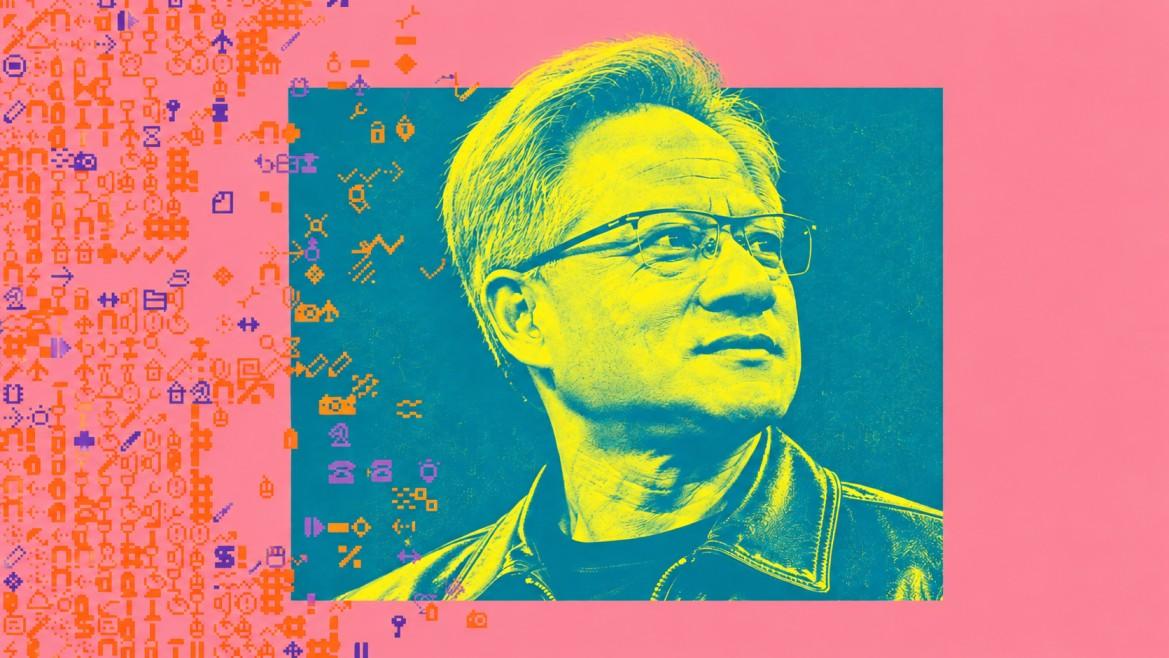
Over the years working in the sphere of enterprise technology, I witnessed many executive departures. The majority of them resulted in a press release and one quarter of worried analysts' phone calls. This week, things were different. Nvidia announced that Jensen Huang left the positions of president, CEO, and board member of the company he co-founded with immediate effect after a thirty-three-year career at the helm. Chief Financial Officer Colette Kress will be appointed interim CEO while the board searches for a new permanent CEO among internal and external candidates.
While the reasons behind the departure, reports about his behavior now under the consideration of the board and Congress, will dominate the news, this is not the topic of the article. The more persistent question is: what exactly leaves the building when the person who is responsible for a whole industry leaves?
A four-trillion-dollar quandary
The stock market response to the announcement has been immediate and decisive. Nvidia's shares dropped by roughly 10%, while Al Jazeera claims the firm has seen its market cap reduced by over $600 billion since news of the case emerged. Meanwhile, AMD saw gains of roughly 3%. As Fortune notes, these results reflect a rational market evaluation of how much of a premium to apply to the stock of a $4.3 trillion business without its founder.
Some elements of the sell-off may reflect pure panic. Others make eminent sense considering Huang's true value to the firm. The CEO had become Nvidia's strategist, salesman, and, perhaps more importantly, its diplomat. It was Huang who bet big on CUDA, a framework that enabled GPUs to serve as general-purpose processing platforms—back in the mid-2000s. It appeared highly unorthodox for a full decade until the rise of AI created an explosive demand for such solutions. What makes CUDA valuable today isn't the silicon itself; it's the massive developer community and model library.
The Cult of the Founder
Valley investors have always idolized the concept of the founder, allocating a significant premium specifically to founder-led companies and backing special funds devoted exclusively to them. Interestingly enough, a manager interviewed by Axios for an article discussing founder-led companies stated that his company would be selling Nvidia stocks should Huang leave because proper succession hardly ever occurs within big businesses. The advisor quoted in Fortune Magazine emphasized Nvidia’s dominance over other players in the industry, describing the company culture as “almost like a cult.”
It seems clear that the premium value only applies while a founder continues running a company. On the positive side, founders enjoy making unconventional strategic moves over extended periods of time, which professional CEOs would hardly suggest before getting approval from the board of directors. From another perspective, however, all the power concentrated in one person translates into a critical weakness point. As engineers working in infrastructure, we learn about single-point failures throughout our entire career.
Strength of institutions, or one-man rule?
Huang had never seen Nvidia as a one-man band. In his interview with Lex Fridman from March 2026, he expressed the belief that there were no typical succession plans. The company had a very flat structure with about 60 direct reports who were providing him with the top-five weekly priorities and information flow that, as Huang claimed, allowed for many leaders to take charge.
This is really solid. Nvidia has good engineering expertise, a well-defined roadmap of products planned for years ahead, and manufacturing partners that would remain even after Huang's resignation. Data centre director Ian Buck and CEO of Arm, Nvidia's former employee Rene Haas, have already been considered for the role. Moreover, as the analysts from Data Center Knowledge noted, the entire infrastructure development of the AI investments cycle does not hinge on Huang's single person.
However, there was the double-edged flat management. According to Axios, dozens of direct reports meant that nobody but Huang had a comprehensive vision of what was happening in the company. A system that aimed to provide information to the top could easily ensure that only the top could see the whole picture. Governance experts were merciless: according to Jeffrey Sonnenfeld from Yale, Nvidia did not plan for a crisis let alone the future (Data Center Knowledge), while Jason Schloetzer from Georgetown University informed Fortune that Nvidia's board made a mistake by not announcing the succession plan. The fact that Nvidia named its first ever board chairman Harvey Jones, the former CEO of Synopsys, says it all.
Relations are not accounted for in the balance sheet
The hardest thing to carry over from the current executive is not technical. As one analyst said to Data Center Knowledge, Huang's connections to Michael Dell and executives from the hyperscalers were established over decades. It holds for government relations too. Huang was the industry's most vocal figure regarding export restrictions, claiming that any limitations on US manufacturers would provide even more freedom for Chinese competitors like Huawei. In hours after the resignation, President Trump himself announced Apple's Tim Cook as the potential successor to Huang, showing that Nvidia's executives are seen as a national issue now.
Relation with artificial intelligence companies was not only about business but also personal. This year Nvidia decided to replace a planned $100bn agreement with OpenAI with an equity stake worth less money, investing $10bn in its competitor – Anthropic. This is not an easy decision to make. And the new Nvidia executive will not be able to make them as easily as Huang did.
A lesson for the rest of the AI business
It’s not just Nvidia. In November 2023, OpenAI learned how quickly a firm unravels when its very identity has been tied to a single person, when its leadership board temporarily ousted Sam Altman from his post and staff and investors quickly demanded his reinstatement. Meta remains tied to Mark Zuckerberg via the structure of dual-class shares. Elon Musk’s firms remain partially dependent on his own reputation.
The exceptions prove the rule. The succession at Microsoft, from Bill Gates to Steve Ballmer to Satya Nadella, and at Google, from its founders to Sundar Pichai, shows that organizations have a shelf life beyond their founders. Perhaps the best example is Apple, which has flourished since the departure of Steve Jobs, under a different type of leader in Tim Cook, whose talents lie in operations management more than charisma.
Key things to watch out for
In the short term, there is no room for speculation. Nvidia is scheduled to report Q3 earnings on 17 November, and it must deliver proof that its roadmap and commitments to its customers have not been derailed. Long term, watch if hyperscalers are quickening the pace of developing their own silicon, if developers are staying loyal to the CUDA platform, and if the board appoints a CEO who will continue or change the direction set by Jensen Huang.
Conclusion
For thirty years, the narrative of Nvidia had always been the narrative of Jensen Huang, and this characterization had been mostly accurate. But with the advent of the era of artificial intelligence, Nvidia, as well as other companies, cannot rely on one person alone. The future may depend more on the ability to create organizations that will outlast their founders. This is something Nvidia will discover very soon.